



On the trail of “German boots”: How the monks from Baruny stole the Kreva miraculous icon
 27 March 2026
In the autumn of 1781, the local community in Kreva was shaken by a daring crime – the miraculous icon of the Mother of God was stolen from the local Church of St. Nicholas. An archival court case, which contains witness testimonies and the crime scene inspection, allows us to reconstruct this story literally hour by hour, the main figures of which became the Kreva priest Jan Liasnieuski and the Basilian monks from neighboring Baruny.
The dramatic events began to unfold directly on the Nativity of the Blessed Virgin Mary – September 8. At that time, terrible bad weather struck Kreva. On the festive day, the main suspect was in the town – the Basilian monk Shyman Vainilovich, who was an invited guest at the parsonage of the Kreva priest Jan Liasnieuski.
Reconnaissance and the night of the crime
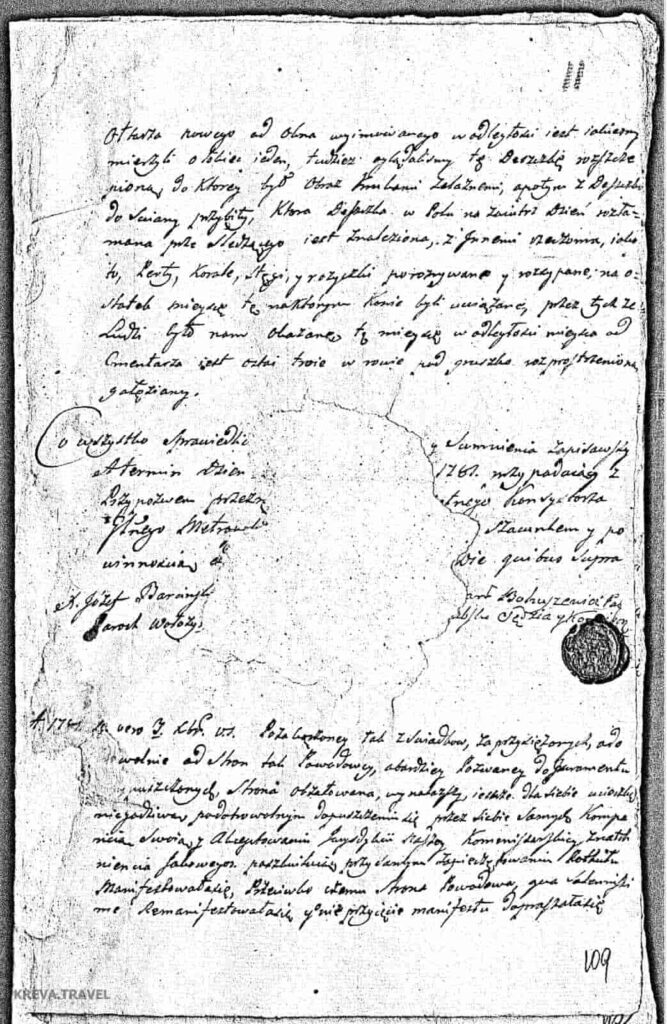
At the court session, which took place on November 24, the prosecution witnesses Viktar Mikhalouski and Yuzaf Maher testified that they saw the monk closely examining the altar for more than half an hour, and also carefully measuring the height of the church windows with his eyes.
After the visit, the priest Liasnieuski instructed his personal farmhand Stefan Kopets to take the monk home to Baruny. During the interrogation, the farmhand admitted that as soon as they left Kreva, Vainilovich gave him a kind of bribe in the form of a small coin and began to ask who and how guards the icon in the Church of St. Nicholas. Having received confirmation that there was no strong guard, the monk that same evening returned on horseback to Kreva together with his accomplice, the local nobleman Pan Sidorovich. A witness from Baruny said under oath that he saw with his own eyes how the monk Vainilovich left the monastery at about six o’clock in the evening.
In order not to attract attention, the thieves did not ride horseback right up to the church. According to the materials of the crime scene inspection, they tied their horses in a ditch under a sprawling pear tree at a distance of approximately three stajas (about 400 meters – ed.) from the church cemetery. To penetrate the closed chapel, they used a wooden log brought with them and took out a window.
The miraculous icon was attached to a massive wooden board in the altar and protected by an iron grate, so the burglars had to literally tear out the shrine with brute physical force.
In hot pursuit
In the morning, the Kreva residents rushed in pursuit. During the night break-in, deep tracks remained on the wet ground after the rain near the church, which the witnesses described as prints of “German boots”. This was a one hundred percent marker that someone not from the locals and not from the common people walked here, but a person of noble or spiritual estate who dressed according to the urban Western fashion.
In the search for the criminals, Jan Leanovich distinguished himself the most. He followed the horse tracks all the way to the mill in Viarebushki. The wife of the local miller confirmed that the riders rushed past late at night in the very storm. Leanovich guessed to take a measure of the hoof prints near the mill – later it ideally matched the tracks near the robbed church. On the way towards Baruny, people found in the field a split wooden board to which the shrine was attached, scattered decorations and coins.
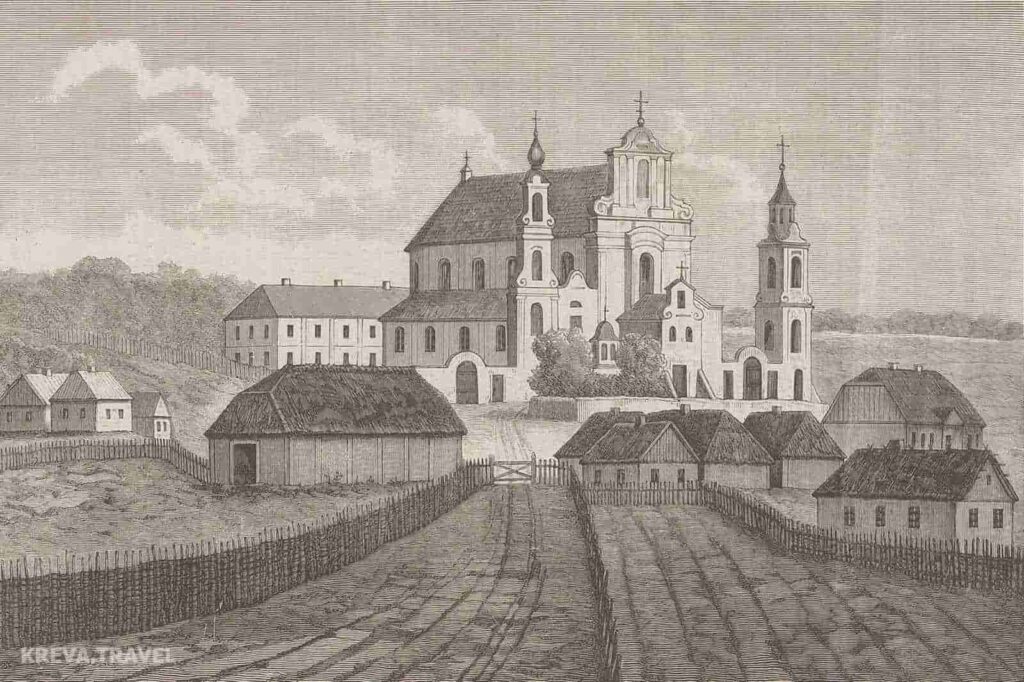
Their own drunken arrogance helped to finally expose the criminals. Vainilovich and Sidorovich made a stop at the local tavern in Papelevichy. Witness Yuzaf Maher reported to the investigative commission that the accomplices drank vodka there and absolutely carelessly boasted aloud of their deed: “See, no one heard in Kreva how we stole the icon from the church”.
What is known about the further fate of the icon
While the investigation was ongoing, rumors swept the town. A local carpenter let slip that he was in a hurry with his work, because the Basilians ordered him to build the stolen Kreva icon into the large altar of the Baruny monastery. A wandering beggar told that the icon was brought to Baruny, but when the local priest wanted to bring it out for mass, he suddenly fell ill with a terrible disease. Therefore, the frightened monks quickly got rid of the shrine. The prevailing version was that the icon “went up with smoke”, that is, it was burned. Witnesses on the part of the monks argued that there was no theft at all, and the icon was cunningly hidden by the Kreva priest Liasnieuski himself.
What actually happened to the shrine and what punishment the criminals received, probably, can be learned from the protocol of the final court session on the case, which was scheduled for November 29, 1781. However, today it is not known whether such a document has survived and where.
