




Candlesticks from cartridges and a chandelier from barbed wire. What the dugout temple at the positions near Kreva was like
 3 March 2024
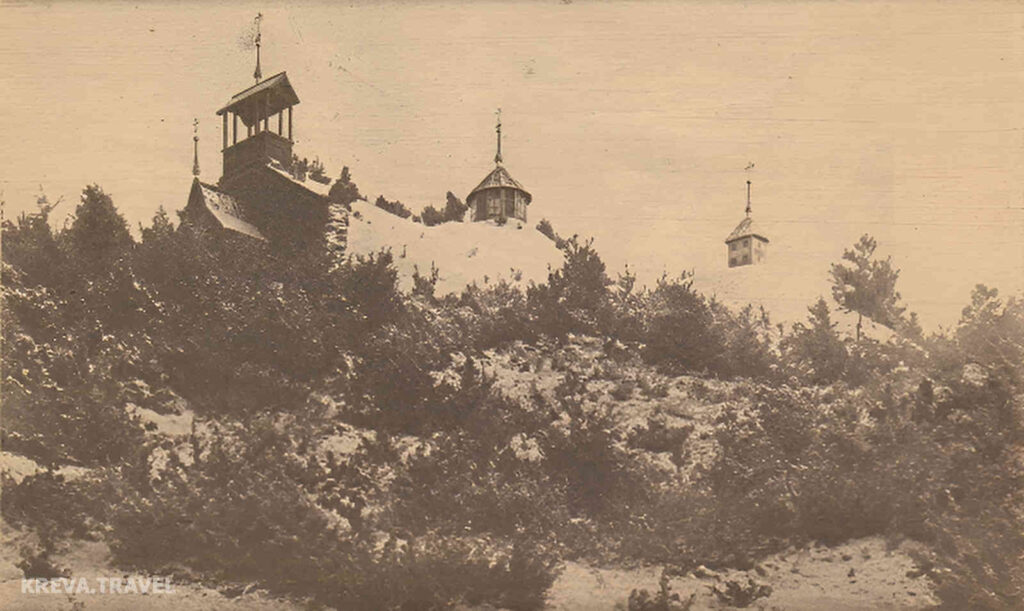
In the Russian magazine “Iskry” on December 25, 1916, an article about a mysterious dugout temple was published. The report was made from combat positions, therefore neither the author of the report nor the exact location were indicated. However, it is known that it is about an object on the territory of the Ashmyany district, and, as it turned out – near Kreva.
Field churches at military formations were a fairly common phenomenon at the front. They often surprised with their architecture and decoration. If not for their temporary nature, they could have been real monuments of that war.
The temple at the Kreva positions was no exception. Its construction was directed by a certain Staff Captain B-sky (most likely, the abbreviation means the rank of staff captain). The church was erected in a three-week period and resembled a dugout. The author of the article notes that from afar it was difficult to determine that this was a church: the building was deeply dug into the hill and merged with it.
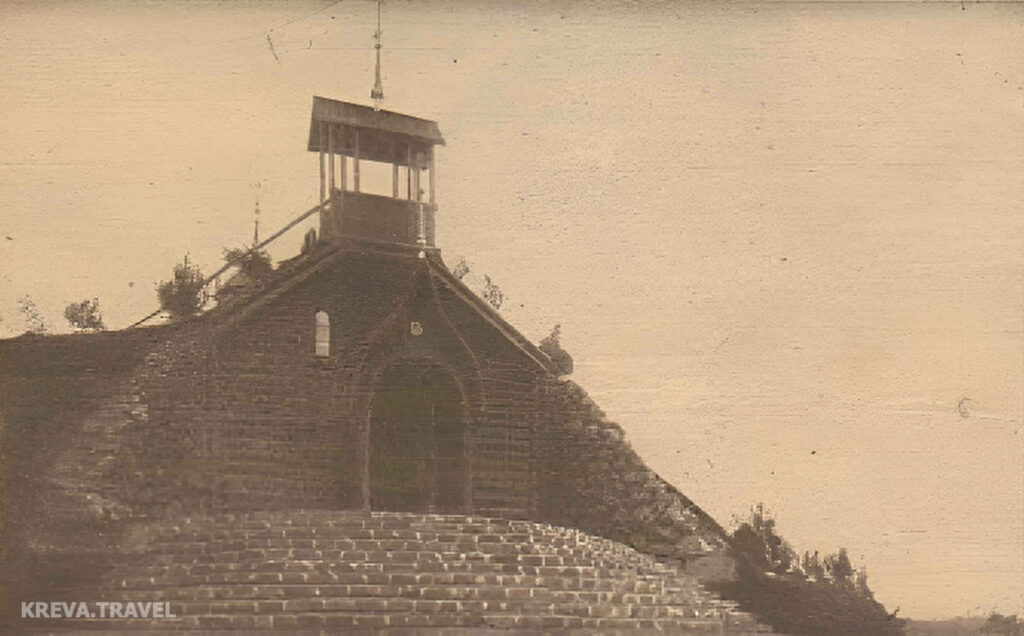
“Only the entrance to the catacomb, lined with wild stones with which one side of the hill was strewn, and the stylish porch and turrets on the hill, in the taste of ancient Bilibin churches and palaces, corresponding to the domes and crowned with crosses, attract attention with their unusual and peculiar beauty”, – the author describes the external appearance.
What the interior was like
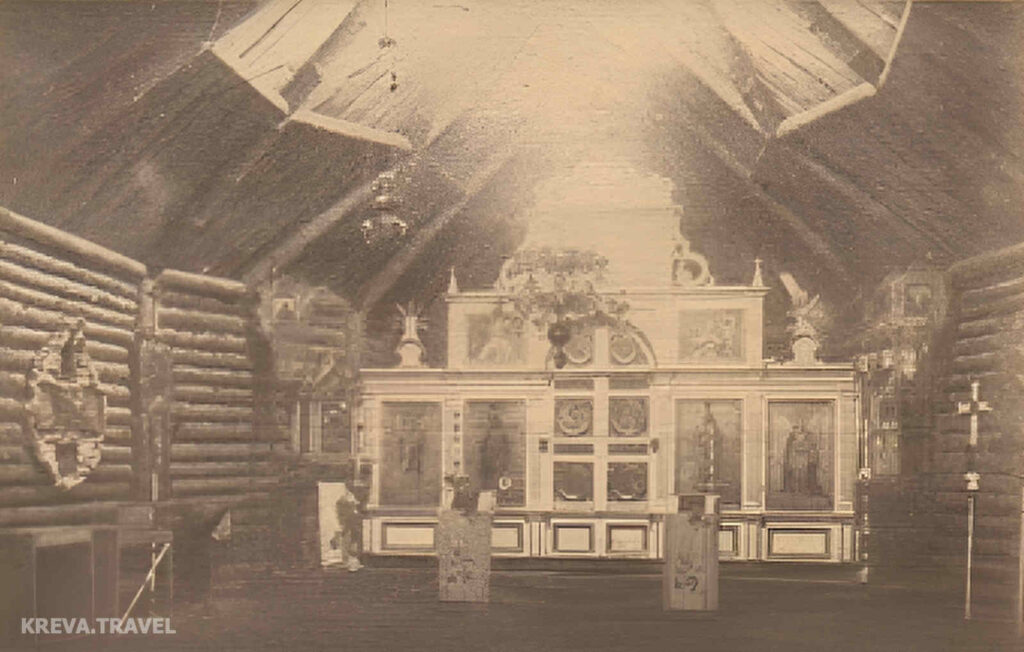
The walls and vaults were built of unhewn slender pines. The dark dugout walls emphasized the unexpected whiteness of the iconostasis. According to the author of the article, shell fragments were inserted into the frames of the iconostasis and the icons, pierced by these same fragments. The military men crafted a chandelier from barbed wire, and metal circles with cartridges soldered to them successfully fulfilled the peaceful role of candlesticks, unusual for them. In one of the corners of the temple, peasant icons were gathered and lined up in a row. Thus, the corner resembled an ordinary icon corner of a Belarusian peasant hut.
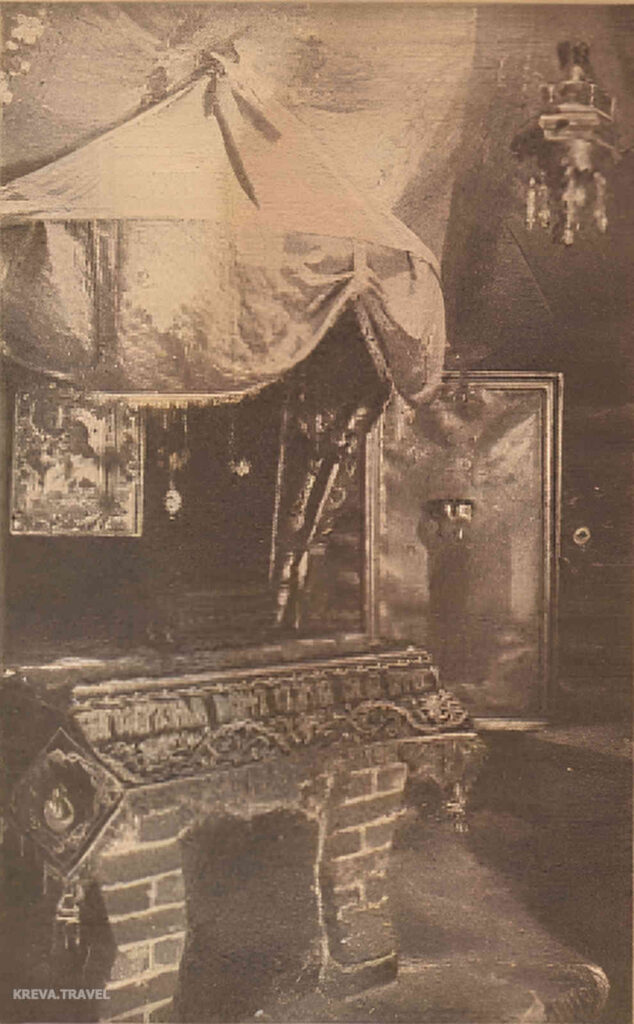
With special care, love, and a deep sense of beauty, B-sky decorated the annex of the temple – a cave where a reliquary with a part of holy relics, obtained somewhere, was kept. A small underground passage led to this sanctuary from the temple. “A beautiful grate made of horseshoes with a shining copper emblem of Christ at the beginning of the underground passage and folding carved doors with an archangel on them, who seems to guard the entrance to the cave with a fiery sword, create an impression of mystery and significance. The cave itself with the relics, which are placed under a brocade cover on a stone table similar to a tombstone, the flickering of the icon lamp and the suffering face of Christ against the background of the black velvet of the draped wall – all this leaves an unforgettable impression of mysterious peace and a prayerful state,” – the front-line correspondent shares his impressions.
Where the temple could have been located
The field temple was erected near the village of D. in the Ashmyany district and consecrated in honor of St. Nicholas, and its iconostasis and utensils were transferred from the half-ruined church of the village of S.
In the Ashmyany district, which once included the lands of the modern Smarhon region, there were not so many villages or towns that began with the letter S, and even fewer of them had churches destroyed by the war. Smarhon is immediately excluded, as at the beginning of the war it was already a city. The Slaveni church was located in the rear on the Russian side of the defense and was not destroyed. This leaves the village of Sutkava, which was located exactly on the border of the Russian-German front. The Sutkava Transfiguration Church, adapted by the Russians at the beginning of hostilities as a field hospital and observation post, was indeed heavily damaged, as it was systematically subjected to German artillery fire. All church utensils could have been transported to a safer place. Most likely, the newly built dugout temple described in the article became such a place. It remains to determine near which village starting with the letter D that distinctive church was located. Most likely, one should look at the Russian positions somewhere near Sutkava. These could be the villages of Daubutsishki (Daubuchki) and Douhi Loh of the Benitsa volost, Draki – of the Smarhon volost, and Dakhny and Doineutsy – of the Kreva volost.
During past local history travels, the Smarhon antiquity enthusiast Uladzimir Prykhach recorded information from old-timers from the Sutkava surroundings about “catacombs of fair dimensions, a part of which came out to the surface,” dug somewhere in these places by Russian soldiers. According to one of the narrators, these were artillery depots. This version is confirmed by information once recorded by a history teacher from Smarhon, Rastislau Shchasny, from a resident of the village of Pasynki, Uladzimir Skrobat, who was born in 1898. He, as it turned out, worked in this very depot during the war.
Right next to the village of Pasynki, where Uladzimir Skrobat lived, there was a settlement starting with the letter D – Draki (modern name – Vyasyennaya). It is possible that the mentioned artillery depot originally was that underground temple. And when the Russians began preparations for their large-scale offensive operation in the summer of 1917, they could have partially or completely adapted it for military purposes.
In the 1950s, a gravel pit was opened on the site of the former artillery depot (and, presumably, the underground church).
